
Clinical Trials · Guide Series
Understand, Join, and Trust Clinical Trials
Clinical trials are carefully designed studies that test medical approaches in people—under ethics review, informed consent, and continuous safety monitoring. This series covers how trials work, benefits & protections, myths vs facts, eligibility, and real stories.
Pain pills. Vaccinations. Cancer therapies. Insulin. Even the cholesterol drugs that help prevent heart attacks. Every one of them was once an experiment in a clinical trial. Treatments that feel routine today only exist because people volunteered to test them when the outcome was still unknown.
It’s easy to forget that behind every prescription bottle or vaccine card is a story, not just of science, but of patients and volunteers who said yes to something unproven. To understand how much it has shaped modern life, you have to look back at the moments when everything changed, the clinical trial case studies…
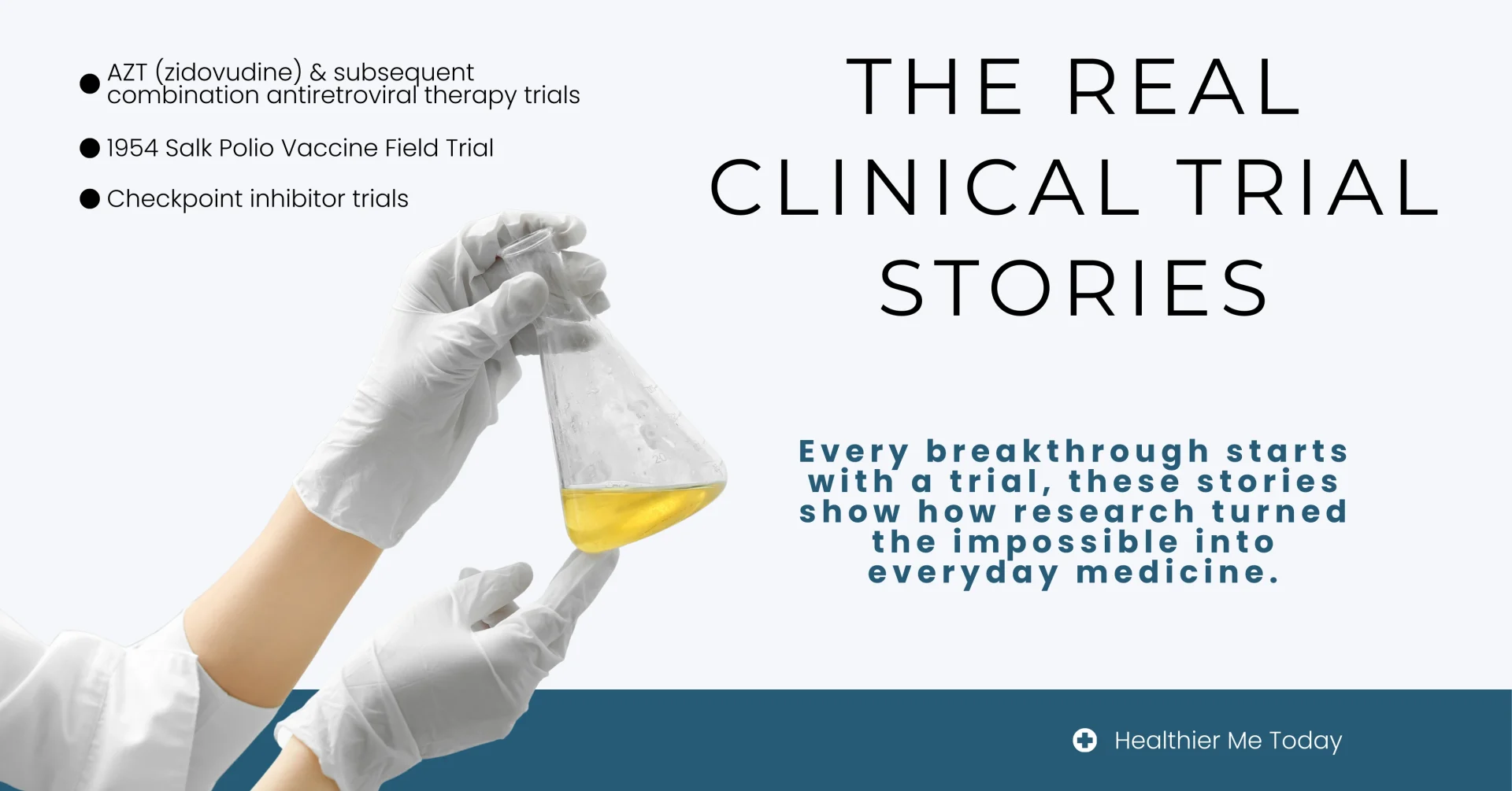
These are the real stories of medicine!
3 Amazing Clinical Trial Case Studies
It’s one thing to say clinical trials change lives, it’s another to actually see how.
Here are three stories that you’ll want to tell anyone (especially those who are unsure of joining a trial):
From Fatal to Manageable [HIV Antiretroviral]
![From Fatal to Manageable [HIV Antiretroviral]](http://healthiermetoday.com/wp-content/uploads/2025/09/From-Fatal-to-Manageable-HIV-Antiretroviral-scaled.webp "From Fatal to Manageable [HIV Antiretroviral]")
Name: AZT (zidovudine) and subsequent combination antiretroviral therapy trials
Date: Mid-1980s (AZT), 1990s (combination therapy with protease inhibitors)
Focus: HIV/AIDS treatment
Participants: AZT trial roughly 300, later combination therapy trials thousands worldwide
In the early 1980s, an HIV diagnosis almost always led to severe illness and death. Doctors could treat infections that appeared along the way, but not the virus itself. The first breakthrough trial tested AZT (zidovudine) in people with advanced AIDS. It asked a simple question: if the virus is slowed, do people live longer? Participants were randomly assigned AZT or placebo, and doctors tracked survival and symptom relief. Results showed shorter hospital stays and improved short-term survival, proving that an antiviral drug could change the course of the disease.
The next step was not a single drug, but combination therapy. Trials compared two drugs vs. three, added protease inhibitors, and used a new lab measure, viral load, to see whether the amount of virus in the blood actually dropped and stayed low. By the mid-1990s, studies showed that a triple-drug regimen could suppress HIV to “undetectable” levels for long periods.
What changed for patients was profound. Deaths plummeted, life expectancy climbed, and further trials showed that treating pregnant patients prevented transmission to babies [viivhealthcare.com]. More recent studies confirmed another pivotal finding that undetectable = untransmittable (U=U), meaning people who keep the virus suppressed do not pass it to sexual partners. This is a clinical trial case study that turned a fatal diagnosis into a manageable chronic condition.
A Million Children, One Answer [Salk Polio]

Name: 1954 Salk Polio Vaccine Field Trial
Date: 1954
Focus: Polio prevention
Participants: About 1.8 million children in the U.S.
In the early 1950s, polio outbreaks closed swimming pools and schools, and paralyzed tens of thousands of children each year [who.int]. Jonas Salk’s inactivated polio vaccine looked promising in lab and small human studies, but the country needed certainty. The 1954 field trial became one of the largest randomized, double-blind studies ever attempted. Roughly 1.8 million schoolchildren were enrolled as “Polio Pioneers.” Some received the vaccine, others got a placebo, or were observed in matched communities. Investigators tracked one clear outcome, paralytic polio.
The results, announced in 1955, were unmistakable, the vaccine was safe and highly effective at preventing paralysis [pmc.ncbi.nlm.nih.gov]. Within months, national immunization campaigns rolled out, later, oral polio vaccines expanded protection worldwide. Incidence collapsed, and polio is now close to eradication in most regions. As a clinical trial case study example of scale, rigor, and public trust, the Salk trial showed how a well-designed study can change a nation’s health trajectory in a single stroke.
Teaching the Body to Fight Back [Cancer Immunotherapy]
![Teaching the Body to Fight Back [Cancer Immunotherapy]](http://healthiermetoday.com/wp-content/uploads/2025/09/Teaching-the-Body-to-Fight-Back-Cancer-Immunotherapy-scaled.webp "Teaching the Body to Fight Back [Cancer Immunotherapy]")
Name: Checkpoint inhibitor trials (ipilimumab, nivolumab, pembrolizumab)
Date: Early 2000s (first melanoma trials), FDA approvals in 2011 and beyond
Focus: Advanced cancers, beginning with metastatic melanoma
Participants: Initial trials hundreds but expanded to thousands across multiple cancer types
For decades, advanced cancers were treated with surgery, radiation, and chemotherapy. Some patients improved, many did not, and benefits often faded. Immunotherapy trials asked a different question: what if the immune system could be unblocked so it recognizes and attacks tumors? Early studies of checkpoint inhibitors (such as anti-CTLA-4 and anti-PD-1 antibodies) enrolled patients with metastatic melanoma, a cancer with poor survival once it spreads.
Trial designs compared immunotherapy to the best available chemotherapy, tracking overall survival, response rate, and how long responses lasted. The surprise was not only more people responding, but the durability of those responses, survival curves developed a “tail,” showing a subset of patients living many years [researchgate.net]. Later trials extended these findings to lung, kidney, bladder, and other cancers, and combinations (e.g., PD-1 plus CTLA-4 blockade) improved outcomes further. New challenges emerged, immune-related side effects, and trials developed management protocols so patients could continue treatment safely.
What changed is the treatment conversation. For many cancers, oncologists now discuss immunotherapy alongside or ahead of chemotherapy. Some patients who once had months now have years with controlled disease [cancer.gov]. As clinical trial case studies go, immunotherapy demonstrates how asking a different question can create a new class of medicine.
Conclusion: So Many More Stories Waiting to Be Told

These are just 3 clinical trial case study examples, but they barely scratch the surface. Behind nearly every pill, vaccine, or treatment available today is a trial that tested it first, often quietly, long before the public knew its impact. From common pain relievers to life-saving cancer drugs, each advance exists because researchers designed a study and patients or volunteers agreed to join.
Progress in medicine isn’t built on chance. It’s built on evidence gathered through trials like these. And while the examples here are famous, there are thousands of other trials happening right now that could lead to the next major breakthrough. Clinical trials are not just history, they’re the foundation of the future of healthcare.
FAQ’s About Clinical Trial Case Studies:
Do participants in clinical trials get paid?
Sometimes [iapac.org]. Many trials offer compensation for time, travel, or inconvenience, but payments are not meant to “buy” participation. The amount depends on the type of trial and how demanding it is.
Did any clinical trial ever go wrong?
Yes. Not every trial leads to success, and some have even raised serious ethical questions, like the Tuskegee syphilis study in the U.S., which withheld treatment from Black men for decades. Situations like this are why today’s trials are governed by strict protections, ethical reviews, and participant rights.
Are there any recent clinical trial breakthroughs?
Absolutely. Recent trials in gene therapy have changed the outlook for children with rare genetic diseases that were once fatal. Other ongoing trials are testing personalized cancer vaccines, Alzheimer’s treatments, and new ways to manage autoimmune conditions. These show how clinical trials are still writing the next chapter in medicine.
Is joining a clinical trial safe?
Every trial goes through strict ethical and scientific review before starting. Participants are closely monitored, and safety is always the top priority. While no study is risk-free, protections are in place to minimize those risks.
Do participants always get the real treatment?
Not always. Some trials use placebos (inactive treatments) or compare new treatments with standard care. However, no one is left untreated, participants either get the standard best care or the new option being tested.
How do people find clinical trials to join?
Doctors often recommend trials, but there are also registries like ClinicalTrials.gov where patients can search by condition, location, or treatment type.
