
Ever wonder how fit you really are? A fitness test for men offers the answer, measuring strength, endurance, aerobic capacity, and flexibility to reveal your true physical potential. These tests go beyond numbers; they serve as tools to track progress over time, set achievable goals, and push yourself to improve. Whether you’re new to fitness, a weekend warrior, or a seasoned athlete, this guide is tailored for you.
This article will walk you through each test step by step so you can assess your current position and your future goals. Are you ready to put yourself to the test?
Why Should Men Take Fitness Tests?
How can you measure fitness? Understanding your current fitness level marks the first step toward owning your health. A fitness test for men isn’t just an opportunity to show off – it is a diagnostic tool highlighting imbalances. Perhaps your Deadlift impresses, but your mile run leaves you winded. Identifying these gaps allows you to customize your training, ensuring strength and balance go hand in hand. Fitness testing tests evaluate your body’s limits while establishing fitness benchmarks by age – because a 25-year-old’s idea of “fit” differs from a 50-year-old’s.

Why does this matter? First, it helps prevent injuries. Weak core muscles might lead to back pain during heavy lifts, while poor cardio could indicate a risk of overexertion. A fitness assessment pinpoints these vulnerabilities, enabling you to address them before they become issues. Beyond safety, fitness tests enhance performance. Want to excel in your next pickup game or hike without fatigue? Regular testing demonstrates improvement and reveals areas that need work. It provides concrete data to answer “How to measure fitness”, replacing guesswork with clarity. For any physically fit male, that’s a game-changer.
Consider this example: A man who can bench press his body weight but struggles with Pull-ups might have underdeveloped back muscles, risking posture problems or shoulder strain. A physical fitness test for men uncovers this imbalance, guiding him to prioritize back exercises. Similarly, someone who excels in short, intense workouts but fades during a 1.5-mile run can use a cardiovascular endurance test to target cardio as the next focus. These insights make fitness tests vital for building a well-rounded, injury-resistant body.
Essential Fitness Tests for Men (Step-by-Step Guide)
How do I know if I am fit? These exercises cover the core pillars of fitness – strength, endurance, cardio, core, and flexibility. You’ll need a notebook, a timer, and perhaps a spotter for safety. This section provides detailed instructions for each fitness test workout, designed to help you measure your fitness progress accurately.
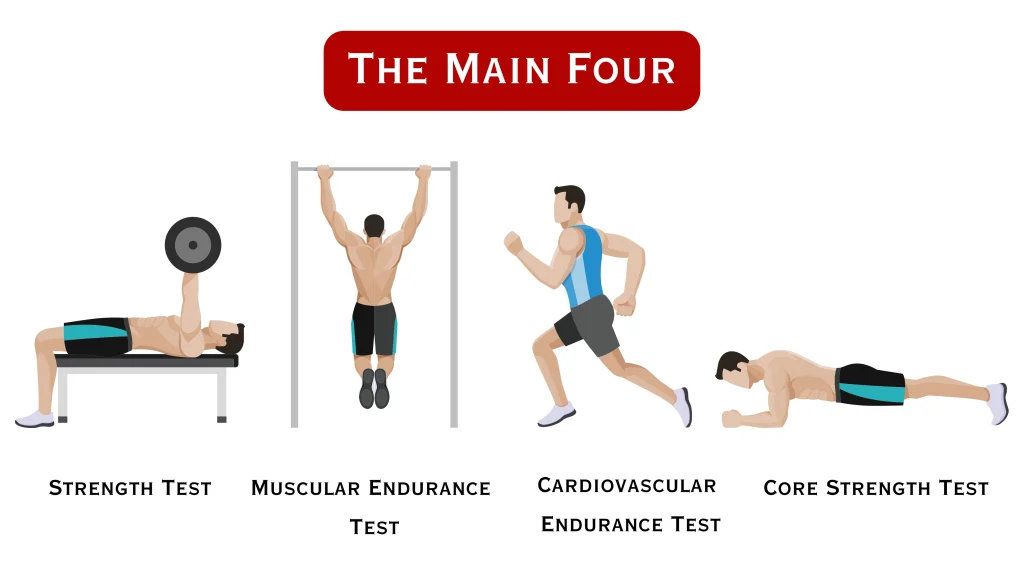
Strength Test: Bench Press, Deadlift, Squat
A muscular strength test evaluates raw power, and the “big three” lifts – Bench Press, Deadlift, and Squat – are the gold standards for fitness testing among men. Here’s how to perform them safely and effectively.
- Bench Press: Lie flat on a bench, feet planted firmly on the ground. Unrack a barbell, lower it to your chest (just above the sternum), and press it back up to full extension. Test your one-rep max – the heaviest weight you can lift once with perfect form. Start with a warm-up: 10-15 reps with the bar, then five reps at 50% of your estimated max, three reps at 70%, and 1- 2 reps at 90%. This prepares your muscles and lowers injury risk. During the lift, grip the bar slightly wider than shoulder-width, keep your back slightly arched, and have a spotter nearby.
- Why It Matters: The Bench Press assesses upper-body pushing strength, a key indicator of overall power for physically fit men.
- Common Mistakes: Bouncing the bar off your chest or lifting your hips distorts results and risks injury. Focus on controlled movement.
- Deadlift: Stand with feet hip-width apart, the barbell over your mid-foot. Bend at the hips and knees, grip the bar (overhand or mixed), and lift by driving through your heels until you’re upright. Lower it back down with control. Find your max, but prioritize form – start light. Keep your back straight, chest up, and the bar close to your body. Drive through your heels, extending hips and knees together, and avoid leaning back at the top.
- Why It Matters: This full-body lift measures posterior chain strength, which is essential for functional fitness.
- Common Mistakes: Rounding your back or jerking the bar can strain your spine. Lift smoothly and deliberately.
- Squat: Rest a barbell across your upper back (not your neck), your feet shoulder-width apart, and your toes slightly out. Squat down until your hips reach knee level, then stand back up. Test your max, keeping your chest up and knees tracking over your toes. Warm up progressively, brace your core, and descend by pushing your hips back. Drive through your heels to rise.
- Why It Matters: The Squat evaluates lower-body strength and stability, which are foundational for athleticism.
- Common Mistakes: Shallow squats or inward-collapsing knees reduce effectiveness. Go deep and maintain alignment.
Log your results and compare them to fitness level tests by age benchmarks later.
Muscular Endurance Test: Push-ups, Pull-ups, Plank Hold
A test for muscle endurance reveals how long your muscles can perform before fatigue sets in – crucial for real-world stamina and how to test your fitness level.
- Push-ups: Place your hands shoulder-width apart, with your body in a straight line from your head to your heels. Lower yourself until your chest nearly touches the floor, then push back up. Count how many you can do in 60 seconds with a full range of motion. Beginners can start with knee push-ups; advanced individuals can try decline or plyometric variations.
- Why It Matters: Push-ups test upper-body endurance and core stability.
- Tips: Maintain a plank-like position – don’t let your hips sag or rise.
- Pull-ups: Hang from a bar with an overhand grip, palms facing away. Pull up until your chin clears the bar, then lower fully. Count max reps in one set. If you’re new, use negatives (jump up, lower slowly) or resistance bands. For a challenge, add weight.
- Why It Matters: Pull-ups assess back and arm endurance, which is vital for a physically fit male.
- Tips: Avoid swinging – keep it strict and controlled.
- Plank Hold: Position elbows under shoulders, forearms flat, body straight. Hold as long as possible without your hips dipping or rising. Time it – 60 seconds is a strong baseline. Progress to side planks or leg-lift planks for added difficulty.
- Why It Matters: This tests core endurance, which is essential for overall stability.
- Tips: Keep breathing steadily and with your core braced.
Cardiovascular Endurance Test: VO2 Max, 1.5-Mile Run
A cardiovascular endurance test measures how efficiently your heart and lungs deliver oxygen during exercise. The lab-based VO2 max is the gold standard aerobic capacity test, but the 1.5-mile run offers a practical DIY alternative.
- 1.5-Mile Run: Find a flat track, road, or treadmill. Warm up with a 5-minute jog, then run 1.5 miles as fast as possible. Time yourself – under 12 minutes is solid, under 10 minutes is elite. Cool down with a walk. Pace yourself to avoid burning out early; interval training can help build speed.
- Why It Matters: Aerobic capacity impacts heart health and endurance for daily activities.
- Alternatives: Can’t run? Try a 12-minute swim or bike test, measuring the distance covered.
Core Strength Test: Hanging Leg Raises, Ab Wheel Rollouts
A core fitness test for men evaluates the foundation of your movement. A weak core undermines everything else.
- Hanging Leg Raises: Hang from a pull-up bar, hands shoulder-width apart. Raise straight legs to a 90-degree angle with your torso, then lower slowly. Count reps until the form breaks – 10-15 is strong. Bend your knees if needed, or add a dumbbell between your feet for advanced work.
- Why It Matters: Core strength enhances posture and lift performance.
- Tips: Control the motion – no swinging allowed.
- Ab Wheel Rollouts: Kneel with an ab wheel hands-on handles. Roll forward until nearly flat (without collapsing), then return to kneeling. Time how long you can maintain control – 30 seconds is a good start. Shorten the rollout if it’s too hard initially.
- Why It Matters: This tests dynamic core strength and stability.
- Tip: Keep your core tight to protect your lower back.
Flexibility Test: Sit and Reach
Flexibility ensures unrestricted movement and injury prevention. The Sit and Reach test provides a simple way to measure your fitness progress in this area.
- Sit and Reach: Sit with legs straight and feet against a box or wall. Align a ruler so that zero matches your fingertips. Reach forward without bending your knees, measuring past your toes (+) or short of them (-). A positive score (e.g., +2 inches) is solid.
- Why It Matters: Flexibility aids mobility and reduces strain.
- Tips: Stretch daily – yoga or static holds – to improve.
Fitness Standards by Age: Are You Meeting Them?
How fit are you for your age? Fitness level tests by age account for natural declines in strength and endurance.

This table presents fitness benchmarks for men – use it for your “Are you fit for your age test?”:
| Age Group | Bench Press (1RM, lbs) | Push-ups (1 min) | 1.5-Mile Run (min) | Plank Hold (sec) |
| 20-29 | 1.2x body weight | 35-45 | <12:00 | 120-150 |
| 30-39 | 1x body weight | 30-40 | <13:00 | 90-120 |
| 40-49 | 0.9x body weight | 25-35 | <14:00 | 60-90 |
| 50+ | 0.7x body weight | 20-30 | <15:30 | 45-60 |
These standards for fitness testing come from fitness studies and expert guidelines, reflecting age-related changes in muscle mass and cardio capacity. They offer a starting point: genetics, training, and lifestyle shape your results. Below the mark? It’s an opportunity to improve. Above it? Aim higher.
How to Measure & Track Your Fitness Progress
Fitness evolves, and tracking it is essential. To measure your fitness progress, retest every 8-12 weeks using the same fitness test workout. Consistency matters – the same weights, course, and time of day. Use apps like Strong or Fitbod or a notebook to log gains – say, adding 10 lbs to your Squat or shaving 30 seconds off your run.
How to measure physical fitness over time? Watch trends: more Pull-ups, a longer Plank, a faster mile. Pair testing with progressive training – lift heavier, run farther, stretch deeper. Small wins build into significant results, keeping you motivated as a physically fit male.
Common Mistakes & How to Avoid Them
Testing pushes your limits, but errors can skew results or cause injury.
Here’s how to stay on track:
- Incorrect Form: A rounded-back Deadlift or shallow Squat cheats your score. Film yourself or seek feedback.
- Overestimating Abilities: Loading too much on the Bench Press too soon stalls progress. Start conservatively and build up.
- Skipping Warm-ups: Cold muscles underperform. Do 5-10 minutes of dynamic moves, such as leg swings, arm circles, and light jogs.
- No Rest Between Tests: Testing multiple areas? Rest 5-10 minutes between (e.g., Bench Press to Deadlift). Fatigue distorts results.
- Inconsistent Conditions: Test under similar circumstances – same time, nutrition, sleep – for accuracy.
Avoid these pitfalls to ensure your fitness assessment remains reliable and safe.
Nutrition and Recovery: Fueling Your Fitness Tests
Your diet and rest directly impact your fitness test for men performance.
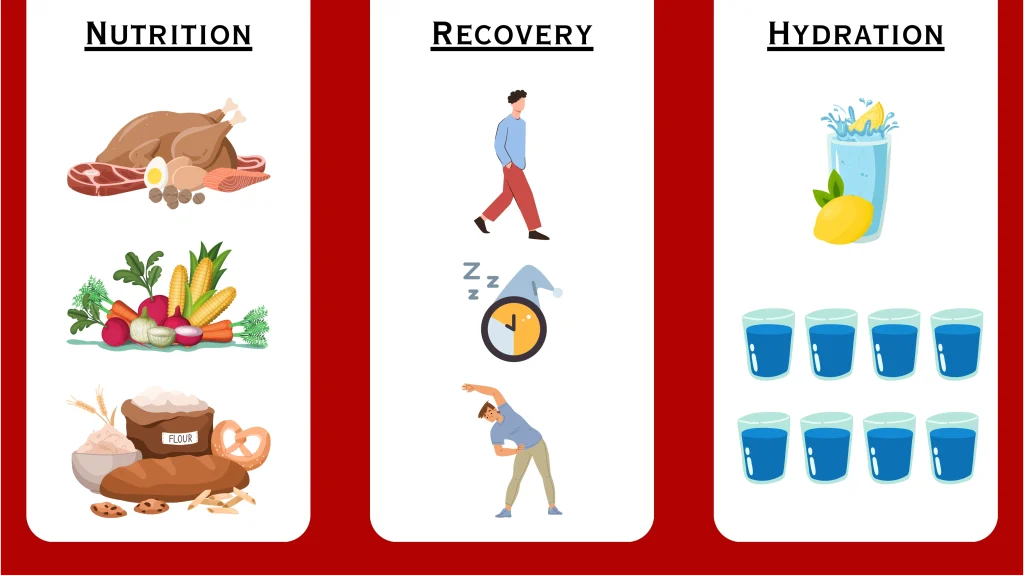
Here’s how to optimize:
- Nutrition: Aim for 1.2-1.6 grams of protein per kg of body weight, plus carbs and healthy fats. Think lean meats, whole grains, and veggies. Eat a balanced meal 2-3 hours before testing and a protein-carb combo after.
- Hydration: Drink 8-10 glasses daily, especially around test time. Dehydration saps strength.
- Recovery: Rest 48-72 hours between strength tests. Sleep 7-9 hours nightly, and use active recovery (walking, stretching) to stay loose.
Proper fueling and recovery boost your standards for fitness testing results.
Mental Preparation for Fitness Testing
Mindset matters. Enhance your how to test your fitness level performance with these strategies:
- Set Goals: Aim for specifics – like 35 Push-ups in 12 weeks.
- Visualize Success: Picture nailing each test to build confidence.
- Stay Positive: Use affirmations like “I’ve got this” to push through.
A strong mental game elevates your physically fit men status.
Advanced Testing Options
Mastered the basics? Explore these advanced fitness tests for men:
- Cooper Test: Run as far as possible in 12 minutes – a tough aerobic capacity test.
- Beep Test: Shuttle runs with increasing speed, testing cardio limits.
- One-Rep Max Variations: Test overhead press or power clean for new muscular strength test challenges.
These push your fitness benchmarks further.
Conclusion: The Bottom Line?
Every man should embrace a fitness test for men. It’s not just about being a physically fit male – it’s about understanding your body, recognizing your limits, and exceeding them. These tests highlight strengths (a killer Deadlift) and weaknesses (a slow run). Start with the “Are You Fit for Your Age?” test today, track your progress, and aim for new fitness benchmarks.
Your journey to peak fitness begins now – how fit are you ready to become?
FAQ’s:
What is a fitness test for men?
A series of exercises – like Squats, Push-ups, or a 1.5-mile run – assessing strength, endurance, and physical fitness.
How can I test my fitness level at home?
Use Push-ups, Plank Holds, or a backyard run with minimal gear – just a timer and space.
What are the best fitness tests for men?
Bench Press, Deadlift, 1.5-mile run, and Plank Hold cover strength, cardio, and core for a full fitness assessment.
How do I know if I am physically fit?
Compare your results to a fitness level test by age benchmarks. Above average? You’re fit. Below? It’s time to work.
What are the strength standards for men?
A 30-year-old might bench his body weight (e.g., 170 lbs), do 30-40 Push-ups, and run 1.5 miles under 13 minutes.
How often should I take a fitness test?
Every 8-12 weeks, balances progress tracking without overtesting.
What is the best way to measure fitness progress?
Retest consistently, log results, and track gains – like more reps or faster times.
How do you test muscular endurance?
Count Push-ups or Pull-ups in a minute, or hold a Plank till failure – stamina over max effort.
What is the best aerobic capacity test?
VO2 max (lab-based) is ideal, but the 1.5-mile run is a simple, practical cardiovascular endurance test.
How does age affect fitness test results?
Muscle mass and cardio decline with age, so standards for fitness testing adjust – e.g., 20 Push-ups at 50 is solid.
